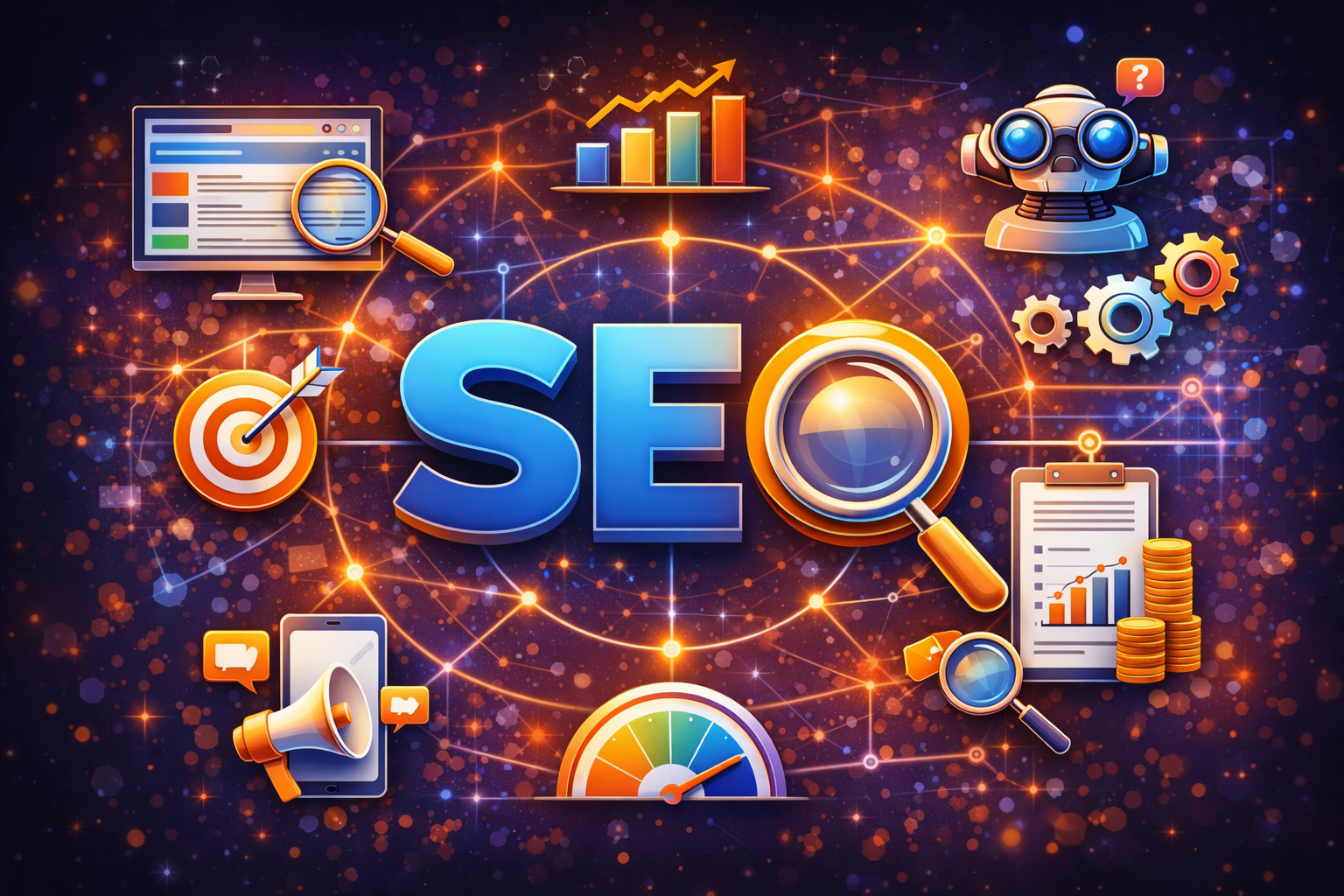
Search Engine Optimization (SEO) Answers
Search Engine Optimization, or SEO, helps businesses appear more often when people search for relevant services, products, and answers. This SEO answers hub explains what SEO means, why it matters, how businesses use it, and which question-led pages to read next if you want clearer traffic, stronger visibility, and more long-term digital authority.
Search Engine Optimization is one of the most important parts of a modern digital marketing strategy because it helps a business earn visibility instead of renting all of it through ads. However, SEO is also one of the most misunderstood topics in marketing. Many business owners know the term, yet they do not always understand what it includes, how long it takes, or why it becomes more valuable over time.
That is exactly why this page exists. Instead of acting like a thin directory or a short category page, this hub is built to function like an educational SEO answer center. First, it explains the topic at a high level. Then, it organizes the key SEO questions people usually ask next. As a result, a visitor can move from broad understanding into the exact answer they need without getting lost.
This page also follows a stronger hub model than the older version. Therefore, rather than simply listing question links, it gives those links context, teaches the subject more clearly, and helps users understand how all the SEO questions connect. In other words, this page is designed to be useful on its own while still guiding users deeper into the SEO answer cluster.
What This SEO Answers Hub Is
Direct Answer: This page is a question-led SEO hub designed to help visitors understand Search Engine Optimization more clearly and then move into the exact SEO answer page they need next. Instead of acting like a shallow archive page, it works as a structured learning and navigation resource.
Many SEO pages fall into one of two weak patterns. Either they stay too short and explain almost nothing, or they try to explain everything in one long block without helping users navigate. However, most people do not learn SEO in one leap. Instead, they learn it through connected questions. They start with the definition. Then they ask why it matters. After that, they ask about techniques, cost, value, timing, and realistic expectations.
That pattern is why a strong answer hub works so well. It matches how people actually search and how they actually make decisions. Therefore, this page is designed to give users a strong starting point, a cleaner understanding of the subject, and a clear path into the verified SEO answer pages already built on the site.
What SEO Means at a High Level
Direct Answer: Search Engine Optimization means improving a website so search engines can understand it, trust it, and show it more often for relevant searches. In business terms, SEO helps the right pages appear when the right people are already looking for what the business offers.
At a high level, SEO is about relevance, clarity, and trust. First, your page needs to match what the searcher is trying to find. Then, your website needs to make that relevance easy for search engines to understand. After that, the site needs enough usefulness and authority to compete against other pages trying to rank for the same searches.
That is why SEO is not just a keyword task. It includes content, page structure, site architecture, internal linking, technical clarity, user experience, and authority signals. Consequently, strong SEO is much closer to a visibility system than a simple content tweak.
This also explains why businesses often underestimate SEO early on. They see rankings as the outcome, but they do not always see the layers that help create those rankings. The better a business understands those layers, the easier it becomes to approach SEO strategically instead of treating it like a mystery.
Why Businesses Care About SEO
Direct Answer: Businesses care about SEO because it helps them appear when people are actively searching for answers, products, and services. That makes SEO one of the clearest intent-driven channels in digital marketing and one of the strongest long-term ways to attract qualified traffic.
Search traffic is different from many other traffic sources because it often reflects active intent. A person searching for a service, a comparison, a solution, or a direct business question is already engaged in a decision process. Therefore, when your business appears clearly in that moment, the visibility can be highly valuable.
SEO also matters because it compounds. Paid ads are useful for speed, testing, and immediate reach. However, paid visibility usually disappears when spend stops. By contrast, strong SEO pages can continue producing traffic and opportunities over time. As a result, SEO often behaves more like a digital asset than a short-term expense.
This is why business owners ask questions like “Is SEO worth it?” or “Is SEO important for business?” They are really asking whether organic visibility deserves real strategic attention. The answer, in most cases, is yes. However, the exact reason depends on the business model, competition, service type, and how well the site turns traffic into leads or revenue.
What Good SEO Actually Includes
Direct Answer: Good SEO includes multiple layers working together, including strong content, on-page clarity, technical structure, internal linking, authority-building, and user-focused page design. It is never just one tactic, and it rarely works well when treated like only one tactic.
Content and search intent
Good SEO starts with useful content that matches real search intent. If the page does not answer what the user actually wants, rankings become much harder to earn and much harder to keep.
On-page optimization
Then, the page needs clear titles, headings, summaries, keyword alignment, internal links, and a logical structure. These elements help both users and search engines understand what the page is about.
Technical SEO
Next, the site needs strong technical foundations. Crawlability, mobile usability, indexing behavior, site structure, and rendering clarity all affect how well search engines can process the content.
Authority and trust
Finally, SEO depends on trust. That may include backlinks, brand mentions, topical depth, helpful content, and other authority signals that make the site more competitive over time.
Because these pieces support one another, the best SEO systems are usually built around coordination rather than isolated tasks. Therefore, businesses that think about SEO holistically tend to outperform businesses that chase one tactic at a time.
How to Use This SEO Answers Hub
Direct Answer: The best way to use this page is to start with the SEO question that matches your current level of understanding. If you are brand new, begin with the definition. If you already know the basics, move into importance, value, techniques, or leverage depending on what you need to decide next.
Some visitors arrive here knowing almost nothing about SEO. Those users usually need the definition first. Others already know the basics but are deciding whether to invest in SEO, whether it is free, or what techniques matter most. Therefore, this hub is intentionally built to support different entry points.
That structure matters because SEO questions are not random. They usually unfold in stages. First comes understanding. Then comes importance. Then comes method. Then comes cost and value. After that, users often ask about expectations, tools, problems, or timelines. Consequently, this page is designed to support that progression naturally.
The simplest way to use this page is this: read the overview sections here, then click the SEO answer page that best matches the next decision or question in front of you.
Featured SEO Answers
Direct Answer: These featured answer pages represent the strongest starting set in the SEO question cluster. Together, they move a user from basic understanding into more practical and commercial SEO thinking.
What Does Search Engine Optimization Mean?
This is the best place to begin if you want the plain-language definition of SEO and a clearer understanding of what the term actually covers. It gives the foundation for every other SEO question that follows.
Is Search Engine Optimization Important For Business?
This page helps users connect SEO to business value. It is useful for anyone trying to understand why search visibility matters beyond rankings and why SEO often becomes one of the most important parts of digital marketing strategy.
What Are Some Search Engine Optimization Techniques?
This answer moves the conversation from concept into execution. It helps users understand that SEO is built through a combination of methods rather than through one shortcut or one isolated trick.
How Can My Small Business Leverage Search Engine Optimization?
This page is especially useful for smaller businesses that want to translate SEO from theory into practical visibility, traffic, and lead-generation opportunities.
Is Search Engine Optimization Worth It?
This question is critical for business owners evaluating budget, priorities, and marketing channels. It addresses the value side of SEO rather than only the definition side.
Is Search Engine Optimization Free?
This page helps clear up one of the biggest misconceptions in SEO by separating “free organic clicks” from the actual labor, expertise, and systems required to earn them.
More SEO Questions
Direct Answer: These additional verified SEO answer pages expand the hub and give users a broader learning path through SEO tools, benefits, concerns, timing, job roles, and related strategy questions.
- Is Search Engine Optimization Important?
- What Are Search Engine Optimization Tools?
- Is Search Engine Optimization Dead?
- What Is Search Engine Optimization?
- What Does Search Engine Optimization Do?
- What Is a Search Engine Optimization Job?
- What Are the Benefits of Search Engine Optimization?
- What Makes Search Engine Optimization So Important?
- What Is the Problem With Search Engine Optimization?
- Why Does Search Engine Optimization Take Longer?
As a group, these pages make the hub more useful because they allow visitors to continue through a full SEO question journey instead of stopping at only one explanation. Therefore, this section should be treated as a deeper answer library rather than as an afterthought list.
How SEO Fits Into a Bigger Digital Strategy
Direct Answer: SEO works best when it is treated as part of a larger digital marketing system. It supports website marketing, strengthens content strategy, creates long-term discovery, and can reduce dependence on rented traffic over time.
Businesses often make the mistake of isolating SEO from everything else. However, SEO is rarely strongest when it stands alone. Instead, it becomes much more effective when the website is built to convert, the content strategy supports user intent, and the business has a clear structure for turning visibility into action.
This is why question-led SEO content can be so powerful. A visitor may first land on an educational page like “What Does Search Engine Optimization Mean?” Then, that visitor may continue into a page about SEO value, techniques, or business leverage. As a result, the site does not just rank for one isolated term. It builds a connected knowledge path that strengthens the whole cluster.
In that sense, this hub is not only about explanation. It is also about structure. It helps organize the SEO topic into a cleaner internal system that is easier for users to navigate and easier for the site to grow from over time.
Common SEO Misunderstandings
Direct Answer: The biggest SEO misunderstandings usually come from oversimplifying the discipline. People often assume SEO is only keywords, only backlinks, or only rankings. In reality, good SEO depends on multiple systems working together.
“SEO is just keywords”
Keywords matter because they help connect pages to search intent. However, pages still need depth, clarity, trust, and usefulness. Therefore, keywords alone rarely create strong long-term rankings.
“SEO is free”
Organic clicks may not be paid for directly, but earning them usually requires work, planning, content, technical support, and consistency.
“SEO should work immediately”
SEO often takes time because search engines need to crawl, interpret, compare, and reassess pages over time. That delay does not mean SEO is weak. It usually means SEO is compounding.
“One tactic will solve everything”
Strong SEO usually comes from alignment, not from a single trick. Content, structure, trust, and technical clarity all reinforce one another.
Clarifying these misunderstandings is one of the main purposes of this hub. When users understand the topic more clearly, they can make much better decisions about what to read next and what to invest in.
Frequently Asked Questions
Direct Answer: These quick answers help users confirm the basics before they move into the deeper SEO answer pages above.
What does SEO stand for?
SEO stands for Search Engine Optimization.
Is SEO important for business?
Yes. SEO helps businesses appear when people search for relevant services, products, and questions. That makes it one of the strongest intent-driven channels in digital marketing.
Is SEO worth it?
For many businesses, yes. SEO can build long-term visibility, support lead generation, and create more durable digital value over time.
Is SEO free?
SEO traffic can feel free after rankings are earned, but the work behind SEO usually requires time, skill, content, and ongoing effort.
What are some common SEO techniques?
Common SEO techniques include content creation, on-page optimization, internal linking, technical SEO improvements, and authority-building through trustworthy references and signals.
Can small businesses benefit from SEO?
Yes. Small businesses often benefit significantly when they build the right service, location, and question-based content around what customers are already searching for.